
What your students
actually receive.
Below is a complete five-week block for one B2 business-English student — every summary, every correction, and the homework that came out of week one. Nothing has been trimmed for the website. Each document was finished before the tutor had closed the video call.
Student name and identifying details changed. Everything else is as it was generated.
One summary is a record. Five is a progress engine.
Because every summary is written with the previous ones in view, patterns surface on their own. A tutor does not have to remember that “should to” was a problem in week one — the week two document says it has gone, and the week five document says what has not.
“You should to fix the report.” Self-corrected twice mid-roleplay.
Absent from all five homework sentences. “I was thinking every time — no to, no to.”
Her own words: “I don’t think about the modals anymore at all.”
No trace in speech or writing.
Error-free in fast speech, roleplay and writing since week three.
“create bottleneck” → “create a bottleneck”.
Three rules introduced. Controlled use good; free speech drops them.
Perfect in drills, absent under pressure — a capacity problem, not a knowledge gap.
Noun-first scanning built. Unmonitored writing still unchanged.
Method revised to noun-production. Verdict recorded plainly: no measurable gain in five weeks.
“If she need.” · “It also don’t create.”
“my team don’t have capacity.”
Five instances: “team meet”, “legal team need”, “content writer prepare”.
Suppressed in roleplay — monitoring was higher — but present in every session to date.
“so team know.” Flagged as the single most consistent pattern of the block.
“Email is more easy for me.”
No comparative errors this session.
“much more busy” — she fixes it and names the source: “Like easier, we did this in the first session.”
Largely automatic.
No comparative errors in the session.
bottleneck · candid · push back · streamline
Uses “bottleneck” unprompted to summarize a reading.
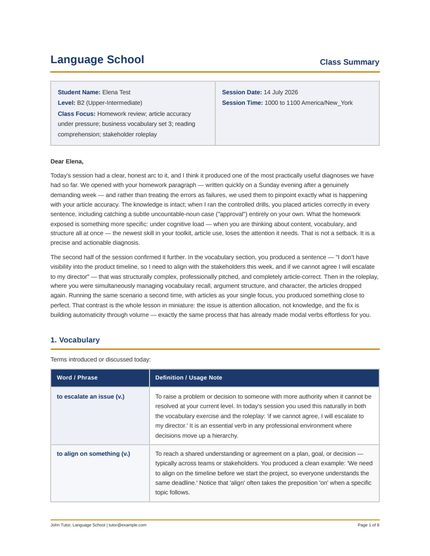
escalate · align · siloed · cognitive load
She separates them herself: “the bottleneck is the system problem, the blocker is the today problem.”
Over thirty items used unprompted, in service of real arguments.
Week by week, in the tutor’s voice.
Select a session. Everything here was written from the lesson recording — the corrections, the rules, the vocabulary notes, and the progress commentary that compares this week to every week before it.
Where it starts
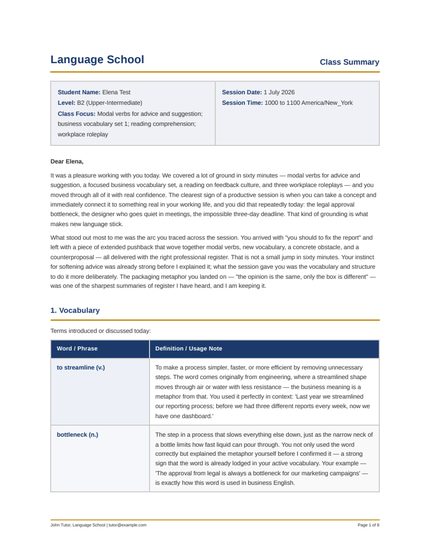
Class focus: Modal verbs for advice and suggestion; business vocabulary set 1; reading comprehension; workplace roleplay
You arrived with ‘you should to fix the report’ and left with a piece of extended pushback that wove together modal verbs, new vocabulary, a concrete obstacle, and a counterproposal — all delivered with the right professional register. That is not a small jump in sixty minutes.Section 6, Your Progress — sent to the student unedited
- You should to fix the reportYou should fix the reportModal verbs take the bare infinitive — never “to”.
- Email is more easy for meEmail is easier for meShort adjectives take -er, not “more”.
- Two years ago I become managerI became managerIrregular past: become / became / become.
- If she needIf she needsThird-person singular -s.
- cancel some meetingcancel some meetingsGeneral categories take the plural.
Every correction arrives with the rule behind it, so the student is not collecting fixes — she is collecting patterns. The summary notes the errors are “systematic rather than random, which means they respond well to focused attention.”
The tutor stopped the recording and the document was ready before the next student joined. Eight pages, no typing.
Vocabulary introduced
What happens next
Every page, exactly as the student received it.
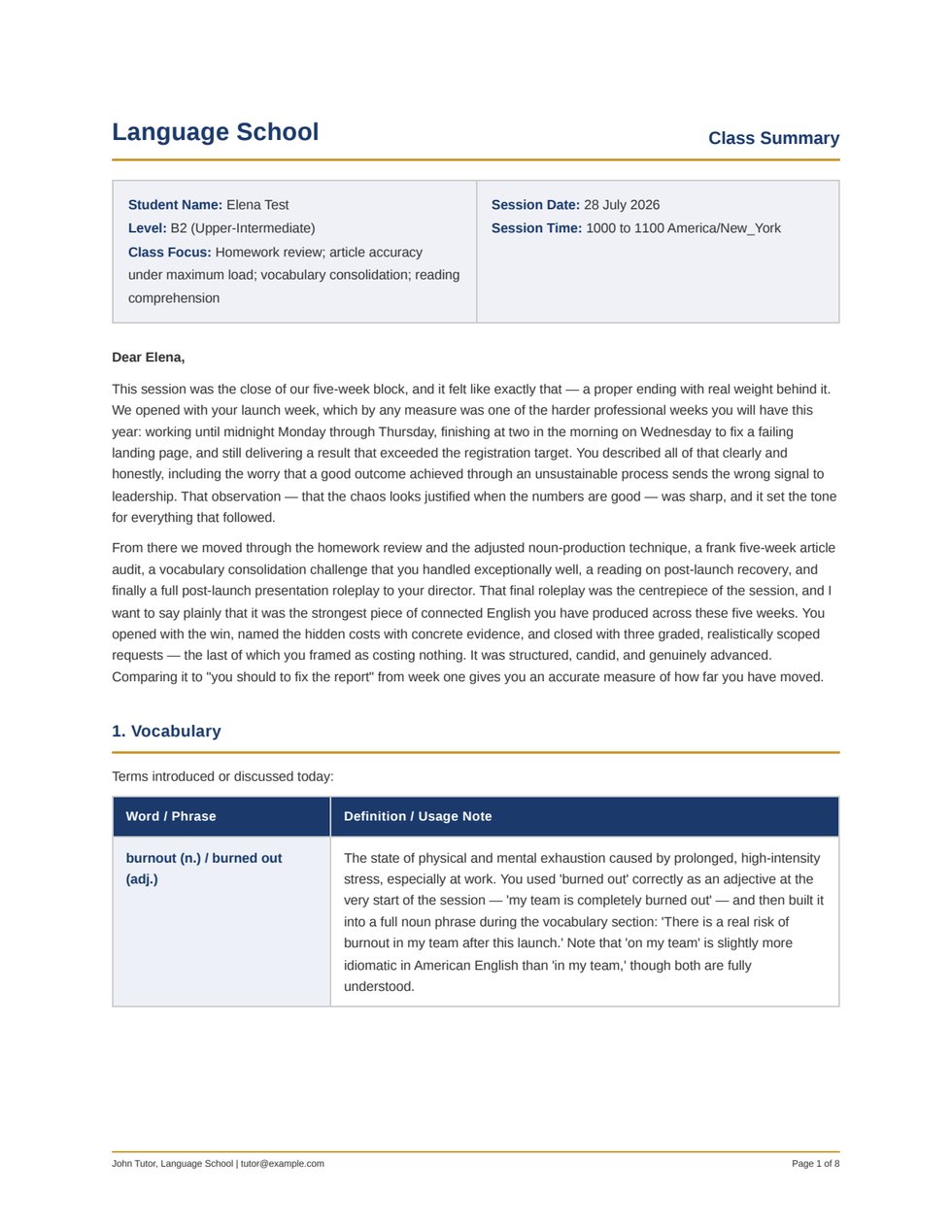
Four pages from the eight-page document, in the tutor’s own branding. Select a marker to see what it is doing and why it matters.
Six documents. Forty-two pages. None of it typed.
Each document on this page was produced in about a minute from the session recording. A tutor writing this by hand — the corrections, the rule explanations, the vocabulary notes, the progress commentary that remembers four earlier sessions — would spend the better part of an hour on each one. Which is why almost nobody does it.
Teach the lesson
Record it in the app, or upload the file from Zoom, Meet or Teams.
Press one button
Sumna works through the session against everything it already knows about the student.
Read it over
It arrives finished and editable. Most tutors change a line or two, or nothing at all.
Send it
Straight to the student's portal or inbox, with the homework attached.
Your students remember the lesson for a day.
This is how they keep it.
Set up your branding once. Every summary, worksheet and exam after that comes out looking like this.
Start free